SPACE GUARD EARTH

SEVEN STEPS OF THE SPACE GUARD

The goal of Space Guard Earth is to detect an asteroid or comet threat as early as possible, assess it accurately and, based on the nature of the object, the warning time and the available capabilities, eliminate the threat or reduce its consequences as far as possible.

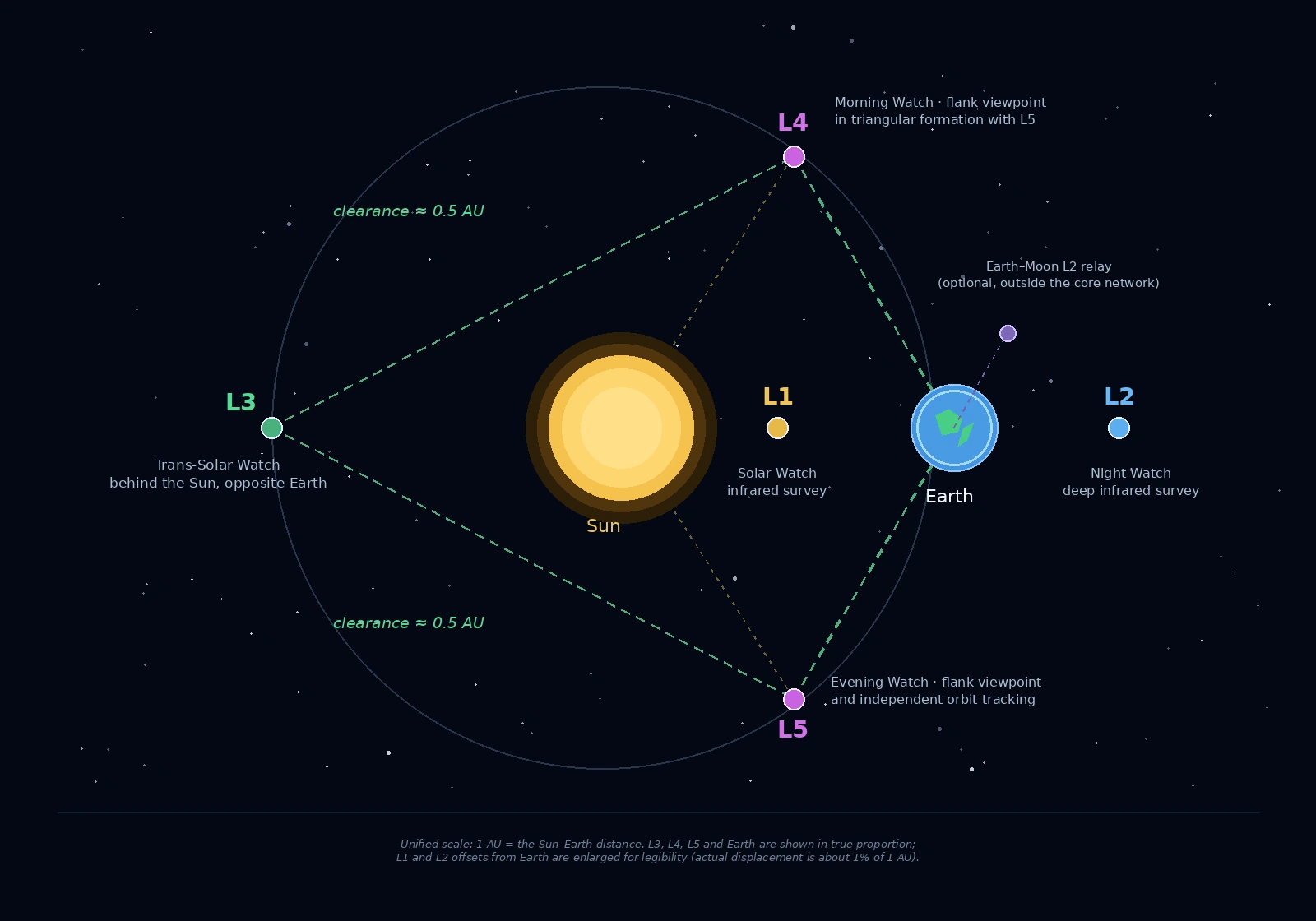
Sun–Earth system with the five Lagrange points L1, L2, L3, L4 and L5

SEQUENCE OF DEVELOPMENT

Seven steps of the Space Guard

The seven steps progressively expand the system from a ground-based intelligent segment to a distributed orbital network. Each step adds a new function or observational viewpoint.

Main result:
earlier detection, more accurate assessment and more time for safe action.
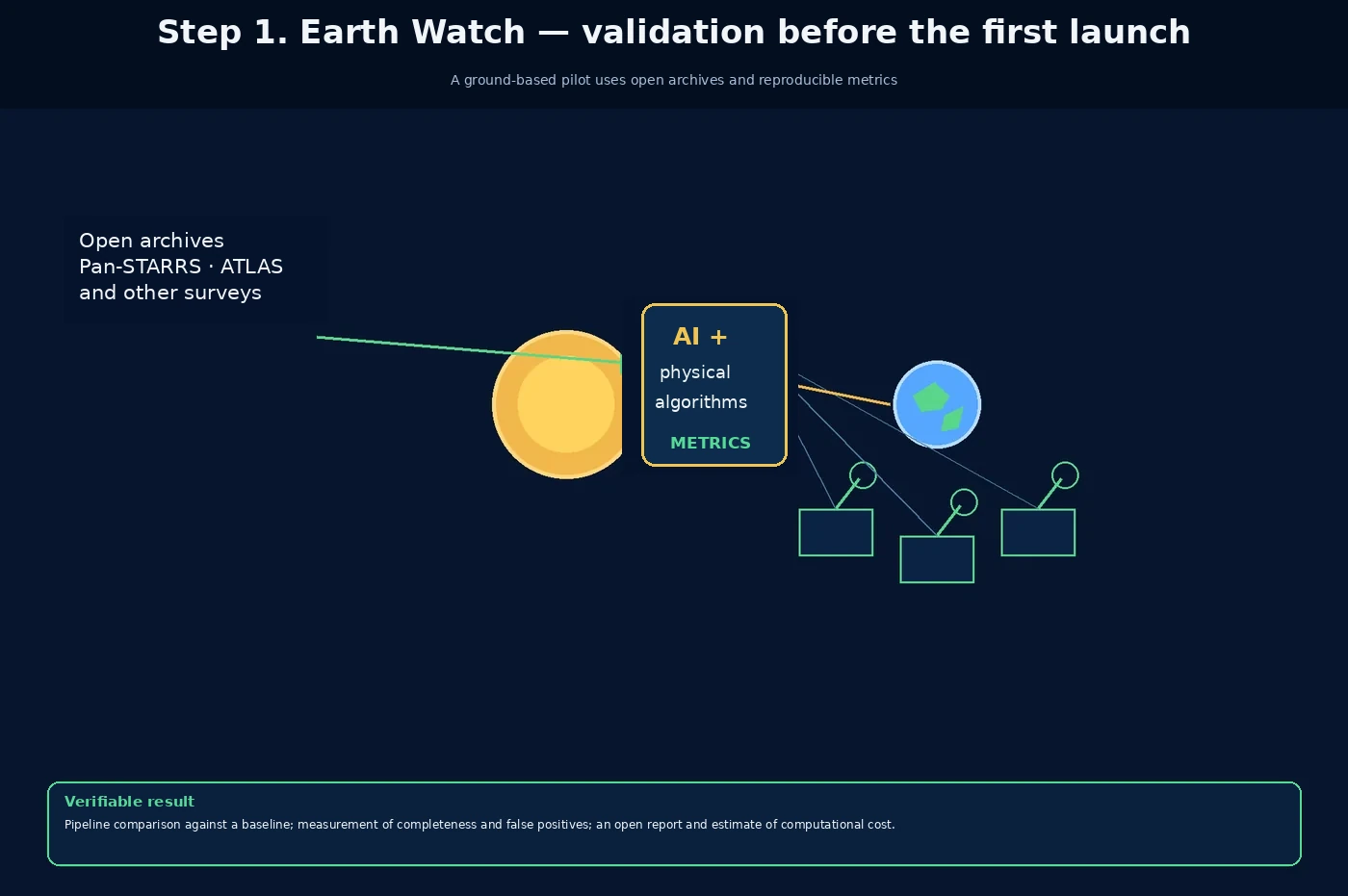
Step one: independent analysis of open astronomical data on Earth
Step 1 Earth

Earth Watch

Begin before any launch: run a reproducible pilot on open survey data and measure detection quality, false positives, computational cost and staffing requirements.

Vulnerability
Fragmented data and limited capacity for manual analysis.
Result
Code, metrics, configuration logs and professional assessment of the protocol.
The initiative’s first practical priority
Step two: an infrared observing segment near Sun–Earth L1
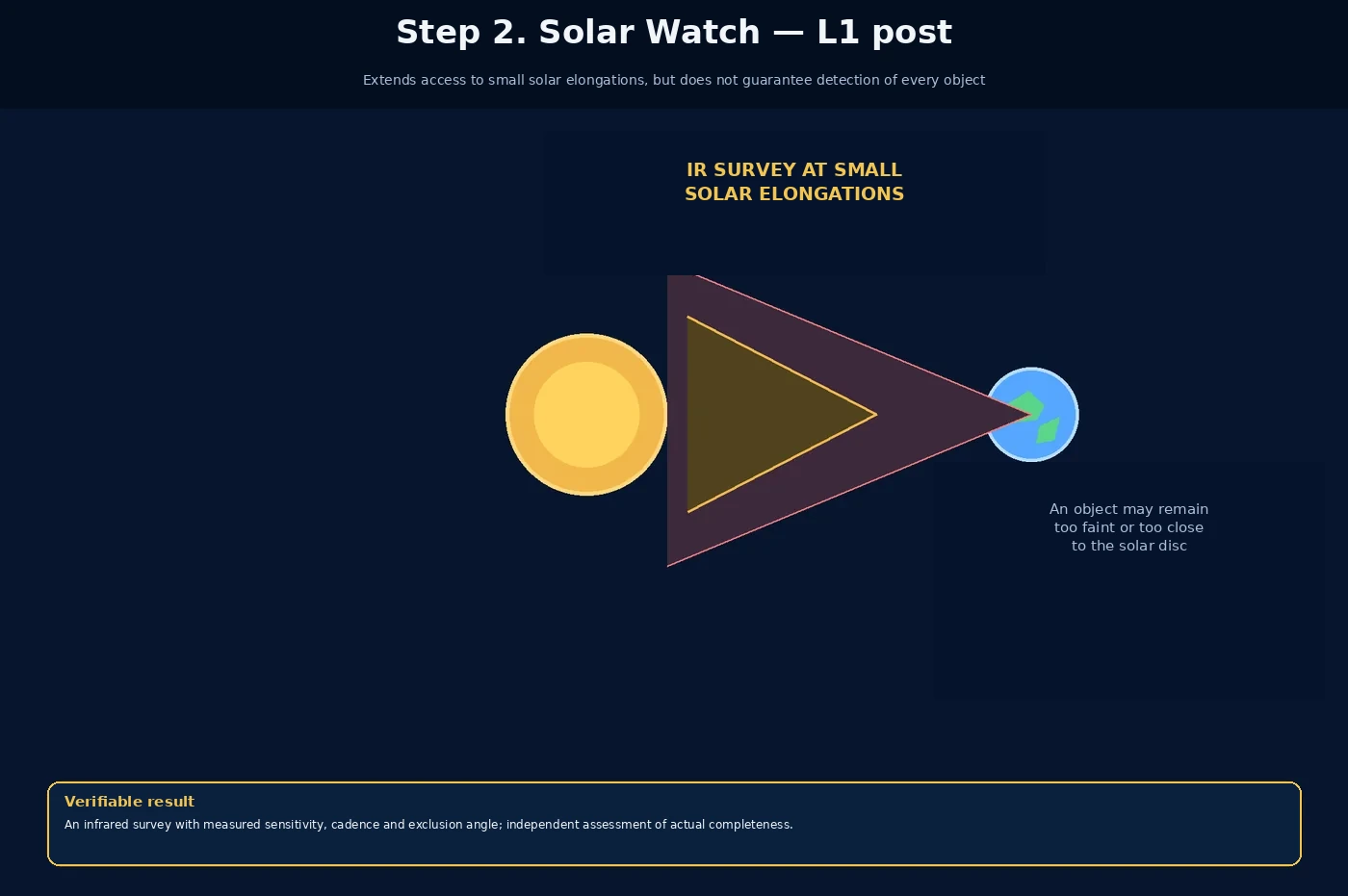
Step 2 L1

Solar Watch

Test the need for and architecture of a first infrared segment near L1, intended to observe objects approaching from directions where ground-based optical systems are constrained by sunlight.

Vulnerability
The solar direction and small elongations.
Before design
Sensitivity, field of view, thermal regime, stray light, orbit and communications.
Candidate first space segment
Step three: a flank observatory near Sun–Earth L5
Step 3 L5

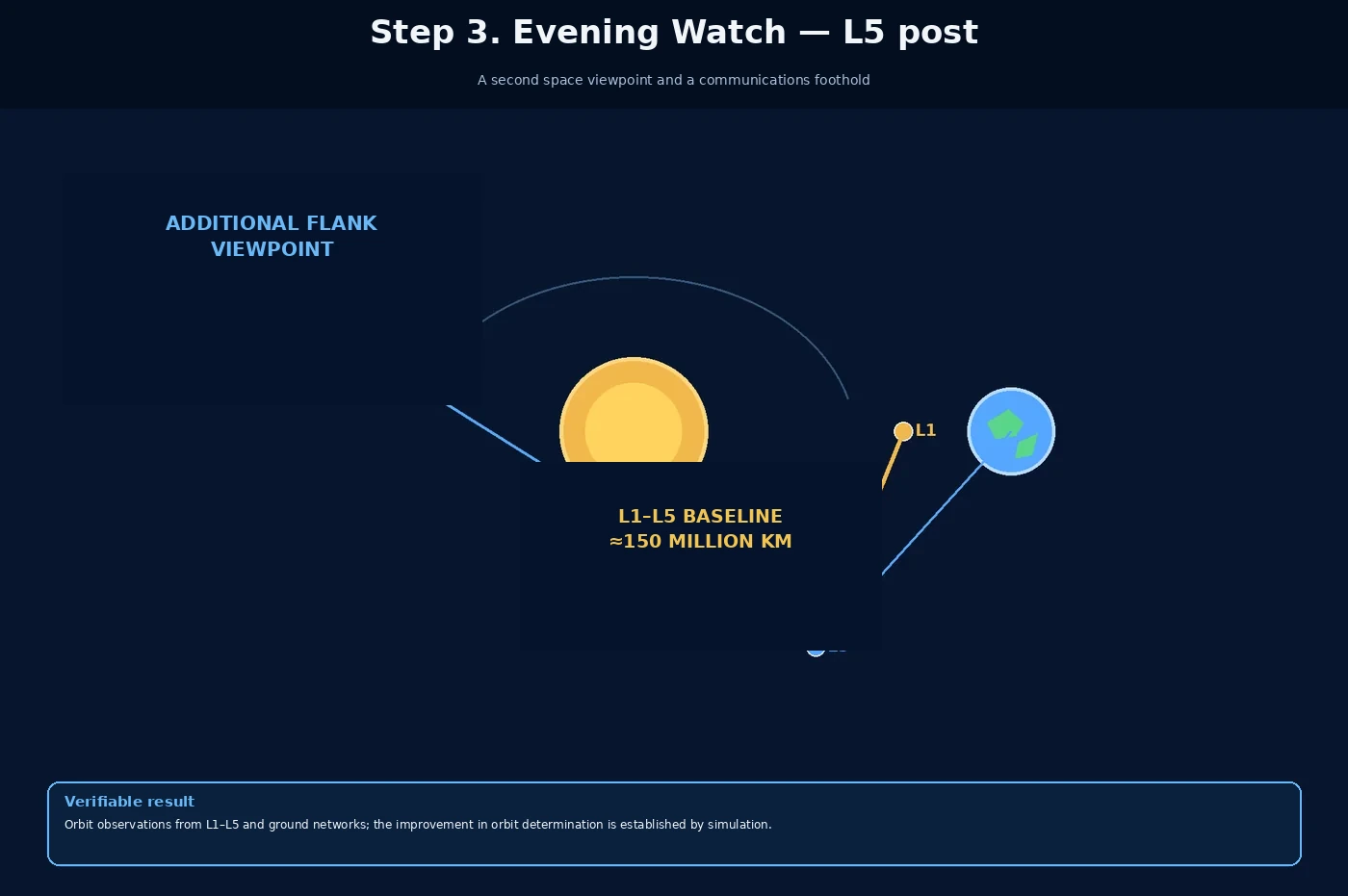
Evening Watch

Add a flank viewpoint near L5. It may broaden observing geometry, improve orbit determination and provide a relay path for more distant segments.

Vulnerability
Limited spatial baseline and dependence on a single viewpoint.
Result
Quantified improvement on simulated object classes.
Flank post of the core network
Step four: a cooled infrared segment near Sun–Earth L2
Step 4 L2

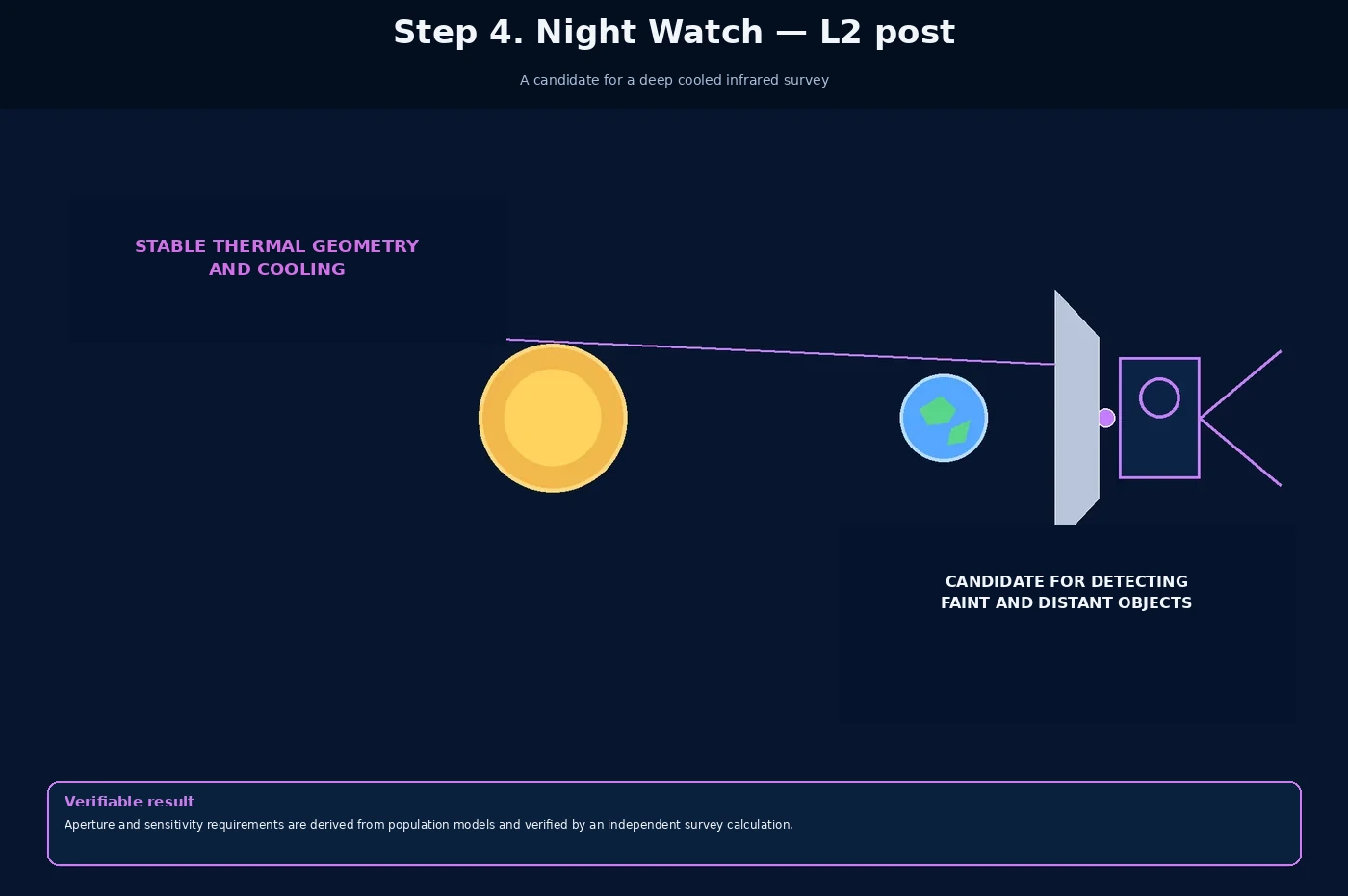
Night Watch

Study a deep infrared layer near L2 — a location with stable thermal geometry that may be useful for faint, distant objects and long-period comets.

Vulnerability
Faint and distant objects with long periods.
Before decision
Compare value with existing and planned missions.
A second infrared layer, subject to validation
Step five: a second flank observatory near Sun–Earth L4
Step 5 L4

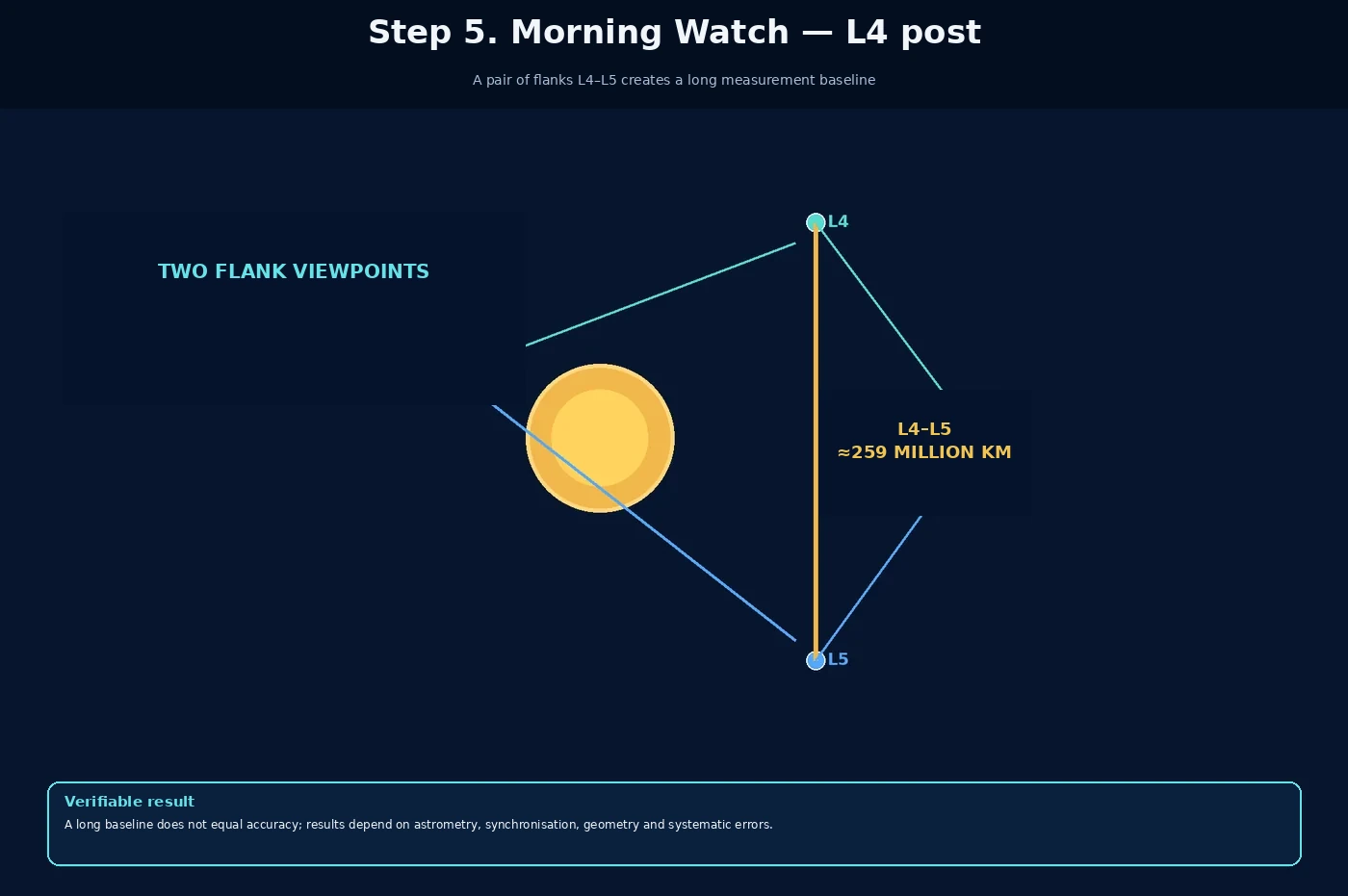
Morning Watch

Create a second flank near L4. L4 and L5 together should be tested for their ability to enlarge the observing baseline, add redundancy and support independent orbit tracking.

Vulnerability
Dependence on incomplete geometry and individual lines of sight.
Result
Reduced orbital uncertainty in numerical simulations.
Second flank post of the core network
Step six: a segment near Sun–Earth L3 with relays through L4 and L5
Step 6 L3

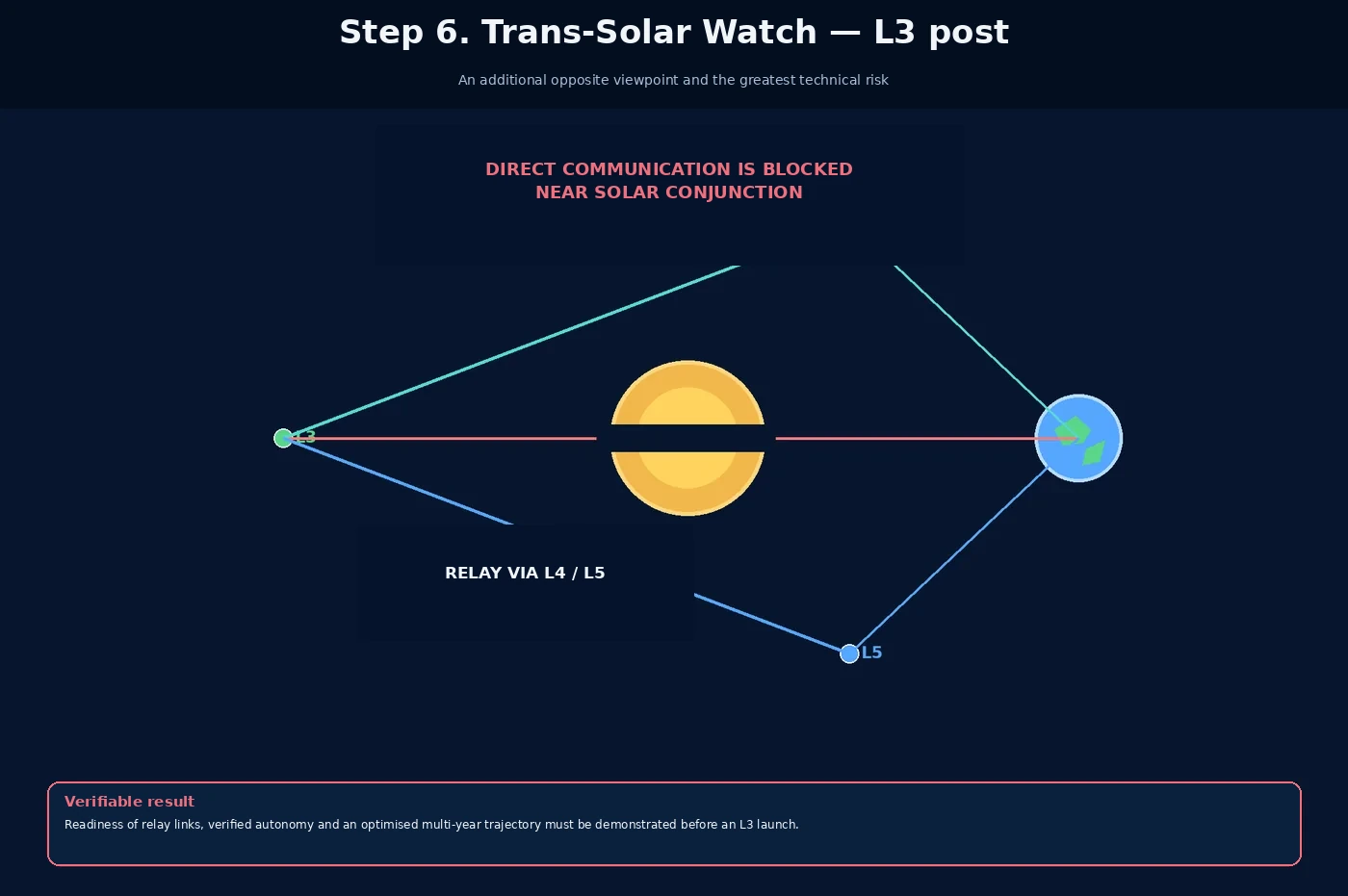
Trans-Solar Watch

Study the most difficult segment near L3 — access to a sector hidden by the Sun from observers near Earth. Direct radio visibility is blocked, so relay through flank posts is required.

Vulnerability
The sector behind the Sun and lack of direct radio visibility.
Critical risk
Delivery, communications, autonomy and maintainability.
The technically most demanding core post
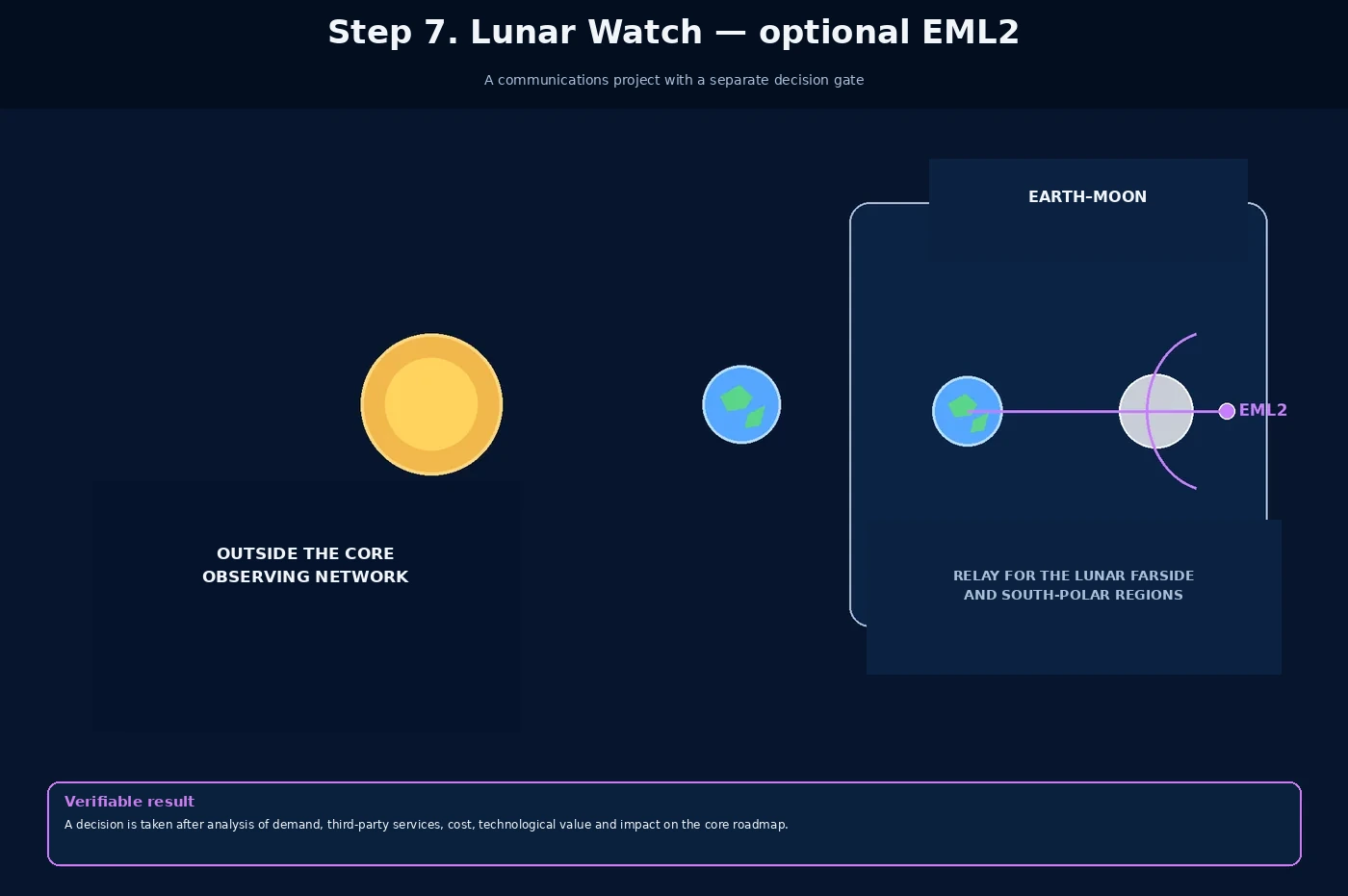
Step seven: an optional Earth–Moon L2 relay node
Step 7 EML2 optional

Lunar Watch

Separately assess a relay node near Earth–Moon L2 for communications with the lunar farside and south-polar regions. It is not part of the core planetary-defence detection network.

Purpose
Communications, not the primary detection function.
Condition
Compare a dedicated node with public and future commercial services.
Optional parallel track

INTEGRATED ARCHITECTURE

Ground intelligence and orbital viewpoints

The proposed system combines open and partner observing streams with a possible L1–L5 network. The space segments are not replacements for ground surveys; they are additional geometries that ground observatories cannot provide.

1
Detection Ground surveys and future orbital sensors generate candidates.
2
Tracking Observations are linked over time to refine range, velocity and orbit.
3
Assessment of results Heterogeneous pipelines, external observations and human expertise.
4
Decision support AI supports analysis but does not declare a threat or choose a response autonomously.
Key boundary: the precision and value of every proposed post must be demonstrated through modelling, uncertainty analysis and independent engineering review before mission approval.
Proposed Space Guard Earth orbital architecture with L1–L5 posts around the Sun and Earth
Project architecture Five Sun–Earth posts; optional EML2 is treated separately.

HISTORICAL EXAMPLES

Cosmic impacts and atmospheric airbursts

The Chelyabinsk asteroid is one of many examples showing the full range of the hazard — from local damage to global change.

01

Chicxulub

About 66 million years ago. Global climatic and biospheric consequences.

02

Vredefort

The largest confirmed impact structure on Earth.

03

Sudbury

An ancient major impact structure and important geological site.

04

Manicouagan

One of the most prominent preserved impact craters.

05

Popigai

A major impact with extensive geological consequences.

06

Barringer

A clear and well-preserved meteorite crater.

07

Tunguska airburst

1908. Regional forest destruction without a conventional impact crater.

08

Shoemaker–Levy 9

1994. The impacts of comet fragments on Jupiter were observed in real time.

09

Asteroid 2008 TC₃

The first asteroid detected before its predicted impact.

10

Asteroid airburst over Chelyabinsk

15 February 2013. An asteroid about 18–20 metres in diameter approached from the direction of the Sun, broke apart high in the atmosphere and produced a powerful shock wave. It was not detected in advance.

OFFICIAL NASA / JPL RESOURCES

See known near-Earth objects right now

NASA/JPL's interactive Eyes on Asteroids visualizes the orbits of known near-Earth asteroids and comets. It is an official external NASA resource that helps convey the scale of the global observing effort already under way.

These links lead to external NASA/JPL websites. Their inclusion does not imply NASA or JPL endorsement of the Space Guard Earth initiative.

LEGACY · A TRACE IN CULTURE

Eugene Shoemaker: the man whose journey continued on the Moon

The history of planetary defence is not only a story of telescopes, calculations and international decisions. It is also the memory of people who taught humanity to understand cosmic impacts as a real natural hazard.

Eugene Shoemaker (1928–1997) was one of the founders of planetary science and established the U.S. Geological Survey’s Astrogeology Science Center. He studied impact craters, taught geology to Apollo astronauts and, with Carolyn Shoemaker and David Levy, co-discovered Comet Shoemaker–Levy 9, whose collision with Jupiter was watched around the world.

After his death, part of his ashes was carried to the Moon aboard NASA’s Lunar Prospector. Eugene Shoemaker remains the only person whose ashes rest on another celestial body.

Contact the initiative